Sport
Is this Clemson's death rattle? Or is Dabo Swinney still capable of righting the ship?
Clemson is 2-1, but with Cal up next, questions still linger around the state of Dabo Swinney's program.
David Hale · 25 September 2026 13:22 · 15 min
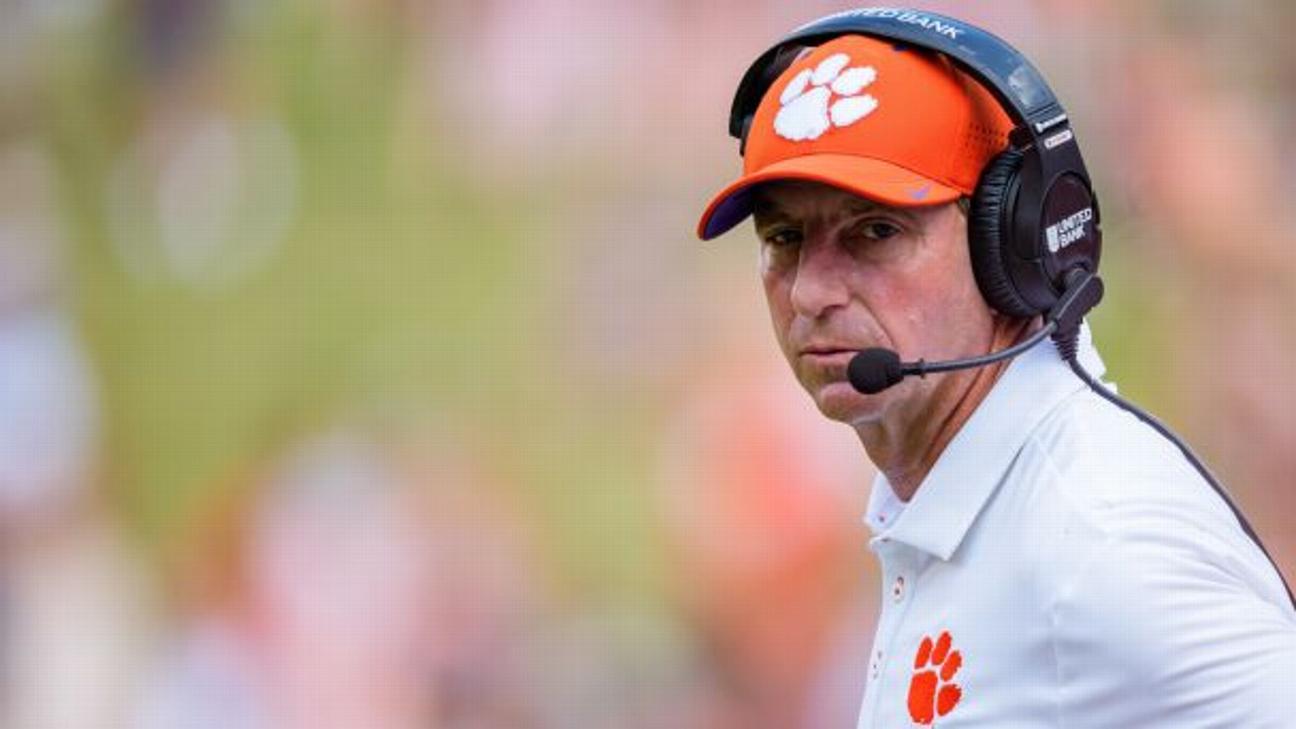
BETWEEN THE TIME Dabo Swinney was fired as an assistant at Alabama and when he landed his next job at Clemson, he worked in commercial real estate -- a salesman carving a niche in the business world, where he learned a thing or two about sustaining success that he later weaved into his philosophy on program building.
For most businesses, Swinney said in 2015, just as Clemson was shoving its way into the upper echelons of college football, their growth chart follows a similar bell curve: the birth, the growth, the plateau, the decline and the death.
"But the great businesses out there, those great programs, they don't plateau," Swinney said. "So how do you do that? You have to constantly reinvent, reinvest, reset, learn, grow. You change. You have to do that. ... I think every successful business, every consistent program, that's a mentality. You can't be satisfied. Because just as soon as you think you've arrived and you're satisfied, then you plateau and then the next thing you know you're on that decline."
From 2015 through 2020, Clemson made the four-team College Football Playoff every year, including four trips to the national championship game (with two wins).
The growth phase was one of the most dynamic in college football history.
From 2021 through 2024, as Swinney so frequently pointed out this offseason amid swirling criticism of the program's regression, Clemson was still quite good -- 40 wins, two ACC titles, the 10th-best record in college football. But the wins were closer, the losses more frequent, and without Deshaun Watson or Trevor Lawrence at quarterback, the cracks had started to show. Then his longtime assistants, offensive coordinator Tony Elliott and defensive coordinator Brent Venables, left for head coaching jobs and a cycle of coordinator changes followed.
The plateau had hit, but Swinney was undeterred.
Then last year -- a season that began with a No. 4 ranking -- the bottom fell out. Clemson finished 7-6 with losses to Syracuse, Duke and SMU, all smaller programs with far less money or pedigree.
The decline was at hand, and Swinney stayed the course.
This year began with a merciless drubbing at the hands of Lane Kiffin's LSU, a slog of a win against Georgia Southern, and until a long lightning delay appeared to reverse their fortunes, another listless march toward a seemingly inevitable loss to a mediocre North Carolina squad.
The numbers certainly suggest a program headed in the wrong direction.
In the 10 years of growth at Clemson from 2011 through 2020, the Tigers were 121-18. In the five years since, they're 47-21.
Against ranked teams from 2011 through 2020, they were 30-14. Since, they're 9-9.
Clemson's average margin of victory during its heyday was 22.8 points. The Tigers dominated often. Since 2021, that margin is down to 15 points and dropping by the week.
The Tigers have lost nine of their past 16 vs. Power 4 opponents.
And while Clemson had its share of ugly losses -- the 2011 Orange Bowl vs. West Virginia, the 2013 Florida State game -- those were few and far between, and they typically were followed by a big step forward by the program. Week 1's blowout against LSU felt like something altogether different -- a funeral.
So, was this the end point of Swinney's famed bell curve, the death of the Clemson dynasty?
Just as the world seemed ready to write Clemson's epitaph last week against North Carolina, the Tigers emerged from a 2½-hour delay like a new team. Its freshman QB, Tait Reynolds, was solid. The defense that had been a complete mess suddenly got some key stops. An offensive line that appeared to have met for the first time 20 minutes before kickoff was now playing in unison, moving defenders and opening holes. This -- this was what Swinney had seen all along, a flicker of hope amid the morass of ineptitude.
Suddenly, there was hope again, a reward for Swinney's unyielding optimism.
"[Reynolds] does have a very high ceiling," one former coach said. "He might end up being the silver lining."
As the Tigers are set to kick off a critical game against Cal on Friday (10:30 p.m. ET on ESPN) -- a cross-country flight on a short week under their belts -- questions still linger. Is this Clemson's death rattle? Or is Swinney still capable of righting the ship, of doing the things he preached were so necessary to a program's success in his early days? "Reinvent, reinvest and reset," Swinney had preached.
"It's not like this is the first program it's happened to," one opposing coach said. "It's the history of the world. All empires fall."
CLEMSON'S DOWNFALL IS not the result of one clear failure, according to more than a half dozen coaches, agents and pundits who spoke with ESPN about the program's status. Instead, it has been a death by a few dozen cuts. At the center of all of them, however, is the same culprit: Swinney's refusal to adapt -- or worse, to admit there's a problem.
One source close to the program called Swinney's approach "stubborn," and lamented the coach's regular rebuffs of criticism, instead insisting the team was "just a few plays away" or offering reminders that Clemson made the playoff -- as the 12 seed -- just two years ago.
"It's like there's nothing wrong [to him]," the source said.
Or, as an opposing coach noted: "If you don't know the problems, you can't find solutions."
Start with the quarterback situation. Clemson's heyday was built upon several elite players at the position -- Tajh Boyd, Watson and Lawrence -- but the production has dipped markedly since. From 2011 through 2020, Clemson posted a 78.1 Total QBR, the fifth-best mark in the country during that span. Since then it's 58.6, No. 68 nationally.
DJ Uiagalelei and Cade Klubnik were both highly touted recruits, but neither developed into difference-makers. This offseason, a plethora of voices urged Swinney to go into the portal and find a veteran who could manage the position, according to multiple sources familiar with the situation.
Swinney insisted on standing pat with three-year backup Christopher Vizzina, who had patiently waited his turn, but who had little game-day experience.
"It was obvious Vizzina wasn't the guy," said one source who had seen enough Clemson practices to feel confident in the analysis.
For Swinney, loyalty is a prized part of a culture that has been the enduring foundation of his program, and Vizzina had played his part. The job was his to lose.
His stat line in parts of two games (before an injury sidelined him vs. Georgia Southern): 4.4 yards per pass, one touchdown, two interceptions.
That Clemson found a potential diamond in the rough in Reynolds offers a glimmer of hope. The Arizona native impressed this spring, pushed for the starting job in fall camp and took over following Vizzina's injury in Week 2. Multiple close observers raved about Reynolds' talent and said the future could be bright.
But as one person close to the program noted, it wasn't Reynolds' arrival that kept Swinney from the portal -- in January, there was no expectation Reynolds would be an immediate factor.
Even a belief in Reynolds' future, however, requires overlooking the present, as Swinney noted after the North Carolina game.
In the final four minutes of the first half, Reynolds handed the ball off into a crowded defensive front. The result was a tackle for loss. Reynolds came to the sideline and found Swinney.
"What are you doing?" Swinney asked.
"I just thought y'all wanted me to hand it off," Reynolds replied.
"What do you mean? Who told you that? Run the offense," Swinney said.
The next play was a 12-yard scramble that picked up a first down.
Swinney told the story as a sign of Reynolds' quick progression, but it also underscored his immaturity at the position -- and it was topped with Swinney lamenting the freshman's overzealous first-down celebration, an immature flourish hardly befitting the situation.
"He sees it, and he gets it," Swinney said, "but even as poised as he is, it's still a big moment."
Teams aiming to play in big games, several sources close to the program noted, have QBs prepared for any moment.
SWINNEY'S DESIRE TO stay loyal has extended well beyond the quarterback ranks.
There has been countless fanfare surrounding his limited use of the transfer portal in general. Swinney has insisted that he is not averse to bringing in players from outside the program -- "if they can help," he has said -- and he has done so with a handful of impact performers in recent years, including star edge rusher Will Heldt.
The bigger problem, according to multiple sources who have evaluated the program, is how Swinney views the players on his roster -- the bar for which he determines whether an outsider "can help."
"The overarching thing is just evaluation," one person close to the program said. "Either the lack thereof or the over-belief in his guys."
Witness an utterly overmatched offensive line this season. A number of those players were highly recruited, including left tackle Brayden Jacobs, but the performance hasn't matched the hype. Through three games, 28% of Clemson's designed runs have been stopped at or behind the line of scrimmage, the sixth-worst rate in the country, while no ACC team has allowed more sacks than the Tigers' nine.
The underperformance of highly touted recruits is a familiar refrain. The 2017 signing class that arrived in the wake of Clemson's first national title had just 11 blue-chip recruits, but it included Tee Higgins, Travis Etienne Jr. and A.J. Terrell -- all future first-round picks -- alongside a number of impact starters such as Matt Bockhorst and Amari Rodgers. Compare that to the 2021 class, which followed the Tigers' last great season, which included 18 blue chips, while only Andrew Mukuba, who transferred to Texas, became a top-100 draft pick.
Swinney, however, remains confident in his players. He sees potential and wants Clemson to be the place where those players meet it. It's an approach that has paid massive dividends over the years with players who played critical roles in the program's development and championships -- from Vic Beasley to Jay Guillermo to Kevin Dodd to Jadar Johnson.
And in an era of program building, the approach might have made sense. But as revenue sharing and the transfer portal has whittled roster depth across the country and emphasized a win-now approach, many coaches are investing more in the current team than a long-term vision developing players for the future, filling needs with portal guys, accepting that some younger players who aren't quite ready will opt to leave as a result.
While Clemson has inked fewer transfers than any other school, it has also seen fewer players enter the portal -- just 43 over the past four years. That's not necessarily a good thing in an era in which the best schools shed dead weight.
"Everybody had one or two of them guys, and Clemson did a good job of putting those [developmental] guys in a position where they were counted on but they weren't stress points," one coach said. "That time is changing. It's harder to do that now."
EVEN FINDING THE right players to develop has become a chore.
Clemson has long had one of the most arduous and refined recruiting processes in the country. The Tigers recruit fewer players overall -- a third of what some power programs offer -- and have strict policies for committed recruits limiting further interaction with other schools.
Even in their prime, the process took its toll on some top recruits, but in an era in which Swinney's pitch is as often to an agent as a parent, the calculus has changed. Multiple sources with direct knowledge of Clemson's recruiting policies said the Tigers were often extremely late in offering top players -- even after assurances were made in order to lure players to a camp or visit -- and the pay scale for incoming freshmen was a fraction of what top programs offered.
"In the high school market, from a financial standpoint, up until really this year -- they're still lower, but they were astronomically lower," one source said.
The goal, the source said, was to keep up the locker room culture by not offering a freshman more than starters were making. That's a potentially admirable position -- one largely taken by other successful programs such as Georgia -- but, the source said, many of the starters aren't particularly good, and even the best of them were often underpaid by market valuations, too.
Clemson's four-year average class ranking is 17th after routinely being in the top 10 during the 2010s and early part of this decade. The Tigers have inked 48 blue-chip recruits over the past four cycles, its lowest tally since the 2015 to 2018 era -- and this comes in unison with a lack of additional talent added through the portal. From 2013 to 2021, more than 72% of Clemson's high school signees were four- or five-star recruits. Since 2022 (including the 2027 commitments), that ratio has plummeted to just 52%. And while few players have departed, the ones who have include a handful of stars, from Makuba (Texas) to Beaux Collins (Notre Dame) to TJ Dottery (Ole Miss).
Multiple sources with knowledge of the situation put Clemson's roster budget at close to $30 million for this season, though that is a sizable step up from a year ago, when the number was in the lower 20s.
Still, it's hard to fault the economics of the new era of college football. While LSU put a team on the field that cost significantly more than Clemson's -- in the range of $20 million more -- but the Tigers far outspend ACC schools such as UNC, Duke and Syracuse, and that advantage hasn't shown up on the field.
That, several sources concluded, was another part of Swinney's loyalty problem. His coaching staff includes a host of former players and longtime friends.
The Tigers' quarterbacks, receivers, running backs, tight ends, linebackers and safeties are all developed by people who've never been in an on-field coaching role outside of Clemson. Meanwhile, nearly two dozen former Clemson players are now working on staff in some capacity.
The result is players who have legitimate ability but aren't producing to their potential.
"They still have the third- or fourth-best roster in the league," a coach said. "But they had a decade of easily the best. And while the roster is good, they're predictable and they don't have an offensive identity."
A former coach referred to "complacency" among the staff as an issue.
After last season's 7-6 record, Clemson saw nine players selected in the NFL draft.
Klubnik, Adam Randall and DeMonte Capehart were all blue-chip recruits with middling results who, while drafted, didn't produce like NFL talent for much of their college careers and likely dropped from where other players of their caliber would've expected to be selected.
Peter Woods was a first-round pick. TJ Parker was taken early in the second. Both were highly touted recruits, both had big moments at Clemson and both were rewarded at the next level. But look back at their total production -- seven combined sacks last year -- and it's hard to suggest the Tigers got the most bang for their buck.
"To have talent like that, [nine] NFL guys combined with that number of wins and being an ACC team," one source in the recruiting industry said, "does not add up."
CLEMSON, ONE AGENT said, is still viewed as a prized destination for recruits -- if no longer at the top tier. And it's true that the Tigers' decline dovetailed with the rise of Georgia to their south, cutting off a critical pipeline of star recruits from the home state of Clemson greats such as Lawrence and Watson. And yes, the economics of the sport have shifted enough that Clemson's once inherent advantages -- culture, facilities, off-field development -- have been tempered in pursuit of dollars.
There is a lot working against the Tigers these days.
But Clemson doesn't have to accept the decline, and it's not too late to stave off the death stage, according to many of the sources who spoke to ESPN about the program. The critical question is whether Swinney is open to doing the things he once said were so essential to sustaining success.
"You don't just change to change, but you have to always challenge yourself each and every year to make sure. 'OK, this may be how we've done it, but is it still the right way?'" Swinney said in 2015. "I think every successful business, every consistent program, that's a mentality. You can't be satisfied."
But this is where Swinney's belief in how to sustain a program runs counter to the path he followed to reach the sport's peak. Had Swinney listened to outside voices, bought into the criticism, relented in the face of pushback from countless voices who thought they knew better, he never could've won two titles.
So, where is the line? When does belief in a process become stubbornness in the face of overwhelming evidence?
"Sometimes you've got to hit a bottom to see it, because you don't get there without being stubborn," the former coach said. "It's hard to totally walk away from something you've had tremendous success with."
Wander the halls at Clemson's football facility, and the reminders of greatness are everywhere -- from the championship trophies to the portraits of Lawrence and Watson and a litany of other elite players who've served their time in Death Valley.
Also on walls throughout the building is a saying Swinney has long been fond of repeating: "Best is the standard."
In the aftermath of Clemson's blowout loss to LSU, Swinney offered a more measured tone.
"I think sometimes you go play games, and especially when you've got a really small margin for error against a great opponent in a tough environment, things can get magnified a little bit," Swinney said. "[Clemson] learned how small the margin for error is [against LSU]."
That margin used to be wider.
That lesson used to be understood implicitly.
That "really good team" for which opponents knew they had to play their absolute best to compete with used to be Clemson.
Regardless of what happened in the second half against North Carolina or what the Tigers do against Cal, or even if Clemson does what Swinney insisted after the LSU game remained possible and finishes 11-1, it is hard to make the case that the program hasn't slipped, hasn't settled for a standard less than the best.
Does Swinney see it? Is he willing to make the decisions necessary to reinvent, reinvest and reset? Can he imagine a future in which his prized culture is even more relevant in an increasingly transactional marketplace, while still accepting that everyone has a price?
Nearly every source who spoke with ESPN expressed doubts, but Swinney himself once delivered the blueprint for a revival.
If he's not willing to remember those words from 11 years ago, he won't be surprised by how the story ends.
"Just as soon as you think you've arrived and you're satisfied, then you plateau and then the next thing you know you're on that decline," he said back then. "Now you don't pay attention to the little things. You don't have the sense of urgency because you're fat and happy. Then it's death. The business is closed."